How we choose materials: the craft behind each guardian
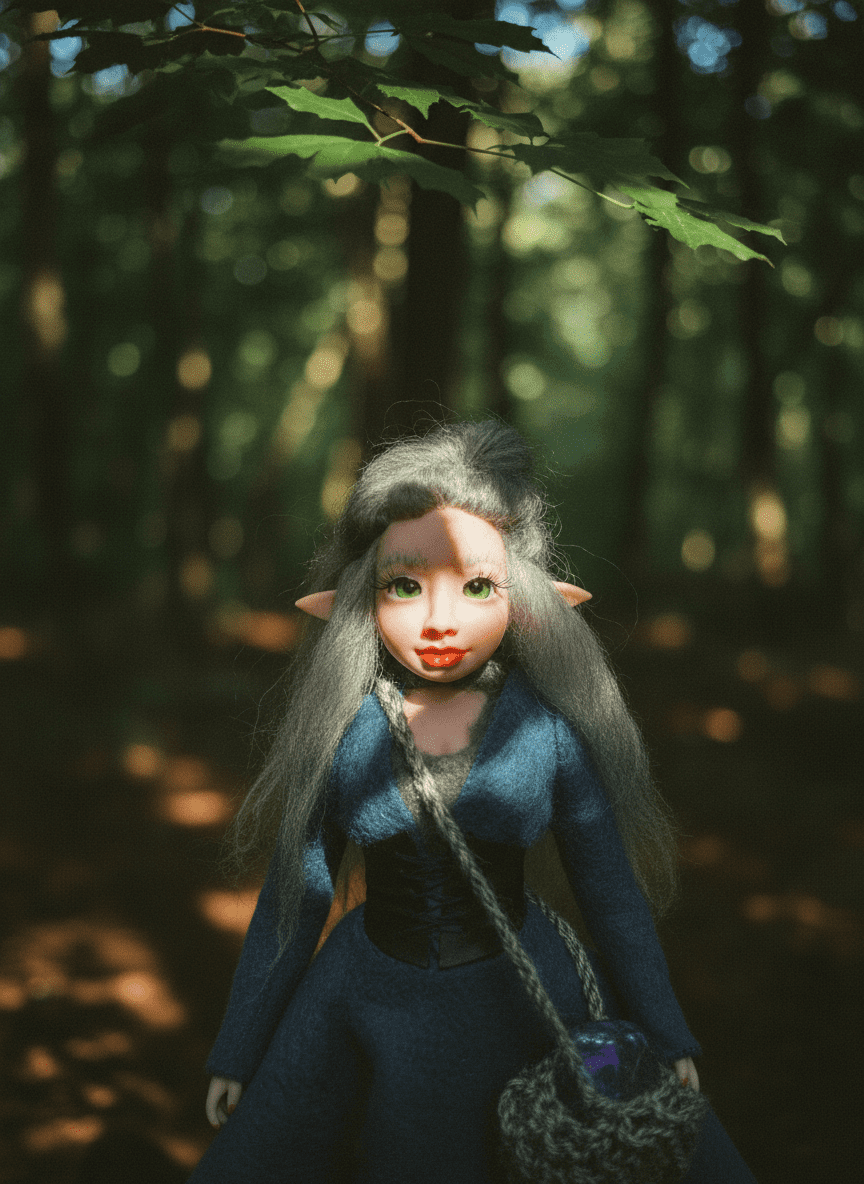
An elemental guardian doesn't just do anything. Matter matters because matter charges the channeling.
The most frequent question we are asked about the trade is: "where do you get the materials from?" The answer is not romantic — but it is honest. I'll tell you.
Wool
Origin
The wool we use comes from small Uruguayan producers. We do not buy in large stores: when we can, we buy directly in rural areas in the center of the country, where families still shear and process by hand.
We have fixed suppliers in Tacuarembó, Lavalleja and Florida. They send us a couple of times a year, by mail or when we go. Traceability is clear: we know which sheep, which field, what type of grass it ate.
Why it matters
A sheep's wool raised on natural pasture has a different quality than an industrially processed wool. It's not just prettier — it's more alive. When we work on it, it responds differently. It fits better into the pipeline.
Processed wool has chemical treatments that crunch the fiber. Not ours.
Types we use
- Fine Merino: for delicate details, fairies and sylphs. Soft, translucent, easy to dye with pastel tones.
- Corriedale: for robust bodies, gnomes, tree spirits. Denser, it keeps its shape better.
- Local Crosses: for guardians with mixed textures. Each cross has its character.
Felts
Origin
We make the felts ourselves from wool that we buy raw. We do not buy industrial felt — that is compacted in such a way that it loses the breath of the fiber.
The process: we wash the wool, dry it, tangle it manually, press it with warm water and soap until we obtain sheets. It's slow work. One day gives us material for two or three medium-sized guardians.
Why we do it by hand
Because machine felt comes with internal tensions — the fiber is forced, not naturally tangled. Our felt flows, it adapts to the body of the guardian as if it were skin, not as if it were fabric.
It's the difference you notice when you see a guardian up close: the matter seems to breathe.
Threads and seams
Origin
Natural cotton and mulberry silk threads for fine details. The silk comes from an Argentine supplier who sends us direct. Cotton is Uruguayan, when we get it without industrial dyeing.
How to choose the color
The color of the thread is not decided before starting. It is decided when the guardian is almost ready. We see what tone the finished piece requires, and we choose the thread at that moment.
Sometimes the color that the piece requests is not what you expected. A Cerros lineage guardian once requested a deep gold thread for his stitches—completely out of his palette of earthy tones. We respect it. And it turned out beautiful.
Crystals
Origin
The crystals that we put next to the guardian when we pack it come from specific suppliers:
- Brazil for rose quartz, citrines and amethysts.
- Argentina for rhodochrosites and agates.
- Uruguay for local agates (yes, there are beautiful Uruguayan agates).
- Bolivia for tiger eyes.
We buy from ethical importers who can trace the miner. We avoid any glass associated with destructive mining — which rules out several large, cheap suppliers. When we doubt, we don't buy.
How to choose which one accompanies each guardian
It is never chosen before. Once the guardian is finished, we leave it on our work table for an hour. Meanwhile, we look at the crystals we have available.
The correct crystal is the one that visually draws attention when we place it near the guardian. There is a resonance: either they see themselves together as if they were from the same family, or they don't. When they don't look good together, we try another.
Sometimes it takes trying three or four until the combination settles. When it settles, we both notice it.
The material also chooses. Not just us.
Herbs
Origin
The herbs that we use to smoke each guardian during channeling are from:
- Our own cultivation in pots and a small patio that we maintain. Rosemary, sage, lavender, rue.
- Local producers (Lavalleja, Maldonado) for Argentine palo santo and myrtle.
- Conscious collection in rural areas with permission, for some specific wild herbs.
We do not use herbs purchased in supermarkets or large chains. Traceability is important because grass carries the place where it grew.
Why some are grown
There are herbs that we need in quantity and that grow well here: rosemary, sage, rue, lavender. We grow them ourselves and use them in incenses, infusions and as an offering in the studio.
Growing your own closes a circle: the herb that goes to your guardian is the one we grew up caring for every day.
Fabric, organza, silk
Origin
Fine fabrics for special details (fairy wings, ethereal tunics, liquid drapes): fabric markets in Montevideo, avoiding industrial chains. We look for remnants from small workshops that make bridal, dance or theater clothing — they are quality fibers left over from artistic projects.
Throwaway philosophy
When we can use a material that already exists instead of buying new, we do it. The job respects the cycle. An organza left over from a dress can be the wing of a sylph — and it carries the dress's history in its fiber. That adds, not subtracts.
Packaging
Origin
Uruguayan recycled cardboard boxes (when for national shipments). For international shipments we use more resistant but equally recycled boxes.
The filling: hand-crumpled kraft paper (not bubble wrap except when it is unavoidable for long distances), sackcloth in some cases, natural tissue paper.
Nothing is perfect — international shipping requires some compromises. But most of the material is chosen carefully.
What we DON'T use
- New plastic: never as visible material of the guardian. As internal support (covered wire skeleton) yes, when necessary for the structure.
- Industrial use glue: we use minimal glue, and when unavoidable, non-toxic type.
- Synthetic paints in large quantities: for specific details, yes. For whole bodies, no — we prefer the natural color of the fiber dyed with natural dyes.
- Chemically treated woods: If a guardian needs a wooden base, we use recycled wood from old projects or dried natural branches.
The price of doing this
This is important: doing things this way costs time and money. It's the reason our guardians don't come cheap. Careful raw materials are worth it, ethical suppliers charge more, the time spent felting by hand can be seen in hours.
We say it without guilt: the prices reflect the real trade. If they were lower, it would be because something in the process was not being respected. And then they wouldn't be the same guardians.
If you are interested in going deeper
Every guardian carries its own combination of materials, chosen for that specific piece. When yours arrives, look at it closely: the wool, the stone, the wood — each one tells part of its story.